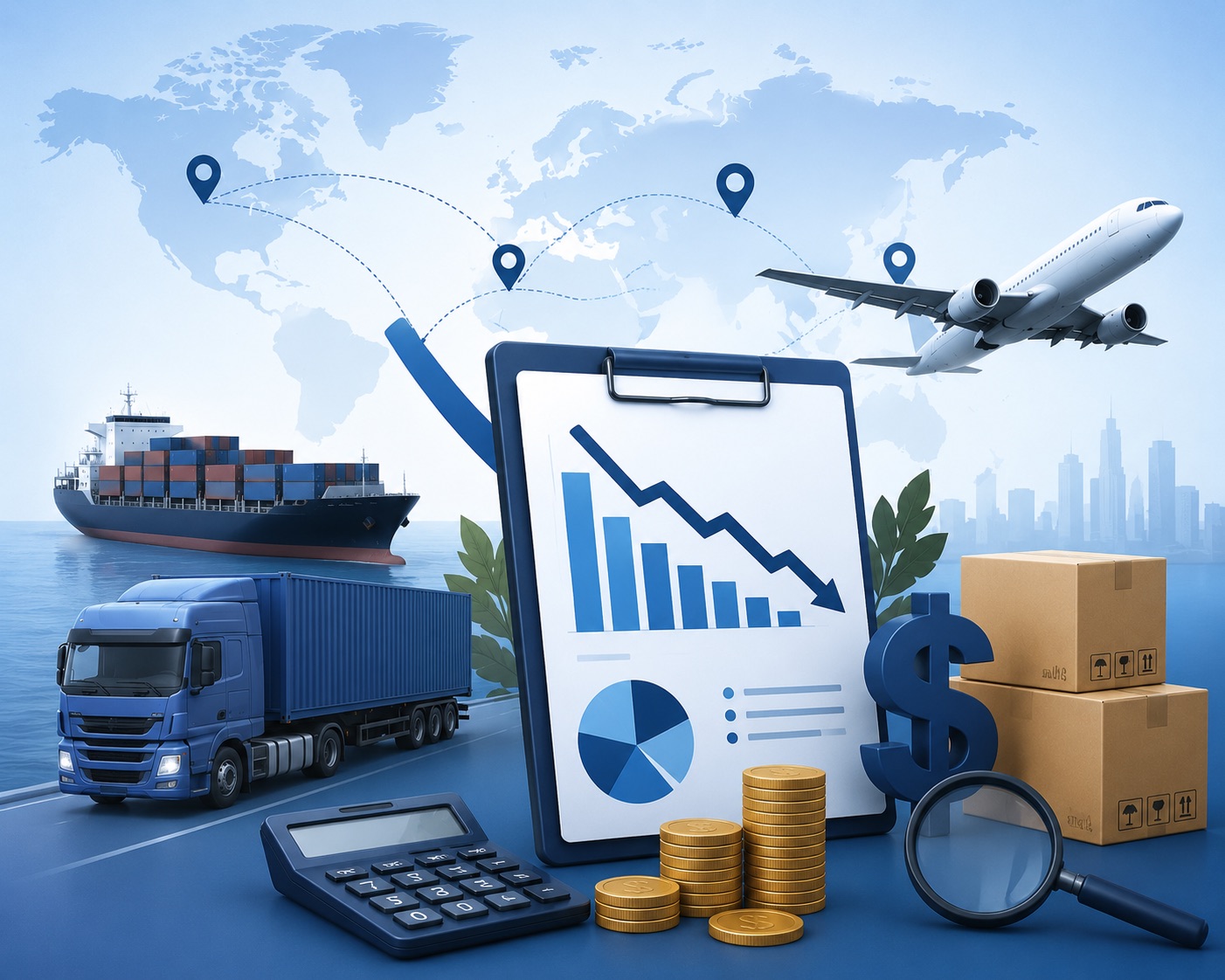
What is a 3PL company? Third-party logistics explained (2026 guide)
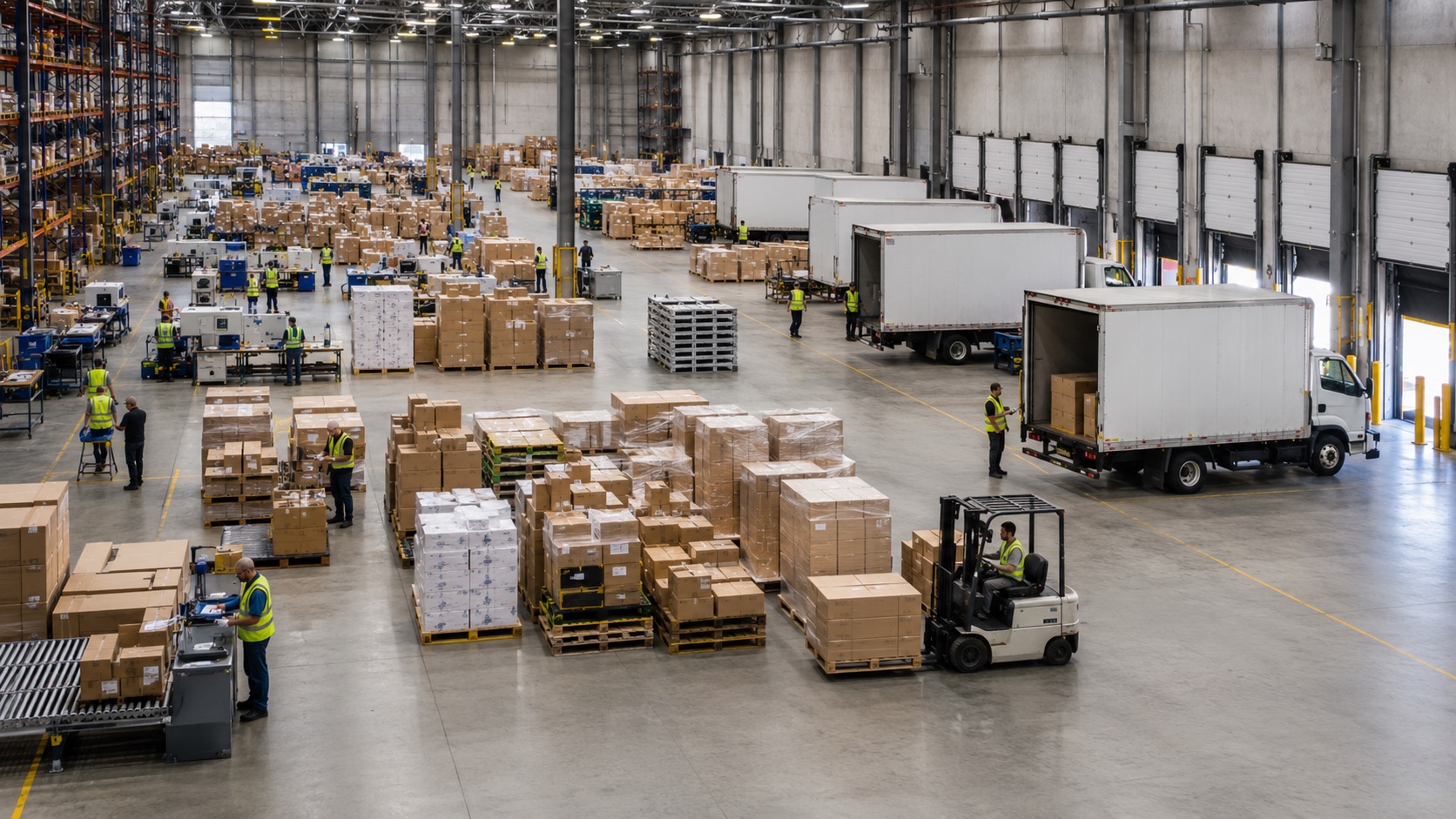
A third-party logistics (3PL) provider is a company that specializes in outsourced logistics operations for shippers, managing warehousing, transportation, and supply chain functions that you would otherwise handle internally.
The global 3PL market was valued at approximately USD 215-230 billion (EUR 200-215 billion) in 2023, according to analyst estimates from Grand View Research and Mordor Intelligence, and is projected to grow at a compound annual growth rate of 7.5-8.5% through 2030, driven by e-commerce expansion, labor shortages, and the rising complexity of multi-channel distribution networks.
Key Takeaways
- A 3PL provider assumes responsibility for warehouse management, order fulfillment, transportation management, customs brokerage, and freight invoice processing, reducing your capital expenditure on logistics infrastructure by 30-50% compared to in-house operations.
- The 3PL market segments into asset-based providers (who own warehouses and vehicles), non-asset-based providers (who coordinate third-party carriers and warehouses), and hybrid models, with non-asset-based 3PLs growing 40% faster than asset-based competitors due to lower operational risk.
- Typical 3PL pricing ranges from €0.50 to €3.00 per unit stored monthly, €1.50 to €8.00 per order fulfilled, and 8-18% of your shipment cost for transportation management, with additional fees for value-added services like customs brokerage or returns processing.
- Choosing a 3PL requires evaluation across six criteria: warehouse location coverage, technology integration capability, freight invoice management practices, flexibility on volume commitments, performance SLAs, and total cost of ownership, not just per-unit fees.
- Freight invoice accuracy is a blind spot for many 3PLs; shippers partnering with 3PLs recover 2-5% of freight spend through invoice auditing, indicating most 3PLs pass through carrier invoices without systematic verification of rate compliance or billing errors.
- 3PL selection decisions drive 15-25% of total logistics costs and directly impact fulfillment speed, returns management, and your ability to scale without fixed infrastructure; poor 3PL performance is difficult and expensive to correct after 2-3 years of operation.
- Integration between your ERP and your 3PL's warehouse management system (WMS) determines operational visibility; inadequate integration requires manual data entry, increasing error rates to 3-7% for order accuracy and delaying visibility into inventory movements by 24-48 hours.
What is a 3PL company?
A third-party logistics provider is an external company that takes on logistics functions previously managed in-house or contracted to multiple carriers. Rather than you owning warehouses, managing a fleet, hiring drivers, and negotiating shipping rates, a 3PL consolidates these functions under one partner.
The term "third-party" reflects the traditional supply chain structure. Your company (shipper) is the first party. Your customer is the second party. Anyone who handles logistics on your behalf is the third party. A 4PL, by contrast, acts as a fourth party by managing multiple 3PLs on your behalf.
The scope of a 3PL partnership typically includes some or all of the following:
1. Warehouse and distribution center operations
Your 3PL manages physical facilities where inventory is stored, picking and packing operations are executed, and shipments are prepared for dispatch. This eliminates your need to own or lease warehousing space, hire warehouse staff, and invest in inventory management systems.
2. Transportation and carrier management
3PLs negotiate rates with freight carriers, consolidate shipments to reduce costs, track shipments, and manage last-mile delivery. For many shippers, this is the highest-value service because carrier negotiation requires scale and expertise that individual companies rarely possess.
3. Order fulfillment
For e-commerce and omnichannel retailers, 3PLs pick items from inventory, pack them according to your specifications, and hand off to the carrier. Fulfillment centers located near customer populations reduce transit times and shipping costs.
4. Freight invoice processing and payment
Many 3PLs manage the billing relationship with carriers, receiving invoices, processing payments, and providing shipper visibility into freight costs. This is often where invoice accuracy becomes critical, yet many 3PLs perform minimal verification.
5. Customs brokerage and international compliance
For cross-border shipments, 3PLs manage customs documentation, tariff classification, duty calculation, and regulatory compliance, particularly important for shipments moving through the EU and between UK-EU routes.
6. Returns management and reverse logistics
Some 3PLs handle product returns, quality inspection, restocking, and remarketing of returned goods, which is critical for companies managing high return volumes or complex product lifecycles.
The value proposition is clear for shippers: you convert fixed logistics costs (buildings, vehicles, staff) into variable costs (per-unit and per-shipment fees), reduce capital expenditure by 30-50%, and gain access to infrastructure, technology, and carrier relationships that would be expensive to build internally.
How 3PLs work: operational mechanics
Understanding 3PL operations requires mapping the flow of information and goods from your warehouse (or your supplier's warehouse) through the 3PL's system to your customer.
1. Receiving and Inventory Management
Your 3PL receives your products either directly from your suppliers or from your existing warehouses. During receiving, the 3PL scans product barcodes, matches physical inventory to purchase orders or bills of lading, and enters data into their warehouse management system (WMS). The WMS tracks inventory location, quantity, and movement through the facility.
This is where data quality begins. If your product identifiers do not match the 3PL's system, or if SKU (stock-keeping unit) data contains errors, the 3PL's inventory records become unreliable. A mismatch between your records and the 3PL's records creates fulfillment errors, backorders, and customer dissatisfaction.
2. Order Reception and Processing
When a customer places an order, that order flows from your e-commerce platform or order management system (OMS) to the 3PL's system. The order contains SKU, quantity, and destination address. The 3PL's WMS searches for inventory and allocates it to the order. This step happens within seconds for high-volume fulfillment centers.
Integration between your OMS and the 3PL's WMS determines how quickly the 3PL receives the order and how accurately they interpret product information. If your system sends unstructured or ambiguous product data, the 3PL must either pause processing or guess, both of which reduce efficiency.
3. Picking and Packing
The 3PL's warehouse staff (or automated systems in high-tech facilities) retrieve the allocated products from shelves, bins, or other storage locations. Products are verified, placed in packaging, and labels are generated. For e-commerce, this might include branded packing materials, inserts, or custom packaging that your 3PL maintains on your behalf.
For commodity or bulk products, picking and packing are faster and less error-prone. For e-commerce with thousands of SKUs, particularly in apparel or electronics, picking errors can run 1-3% even in well-managed facilities. High-tech 3PLs use pick-to-light systems, RF (radio-frequency) scanning, or robotics to reduce errors to 0.5-1%.
4. Sortation and Consolidation
After packing, shipments move to a sortation area where they are sorted by destination zip code, carrier, or delivery method. This is where 3PLs apply their scale advantage. By consolidating shipments from multiple clients, a 3PL negotiates better rates with carriers because they are shipping 500 packages per day to a region, not five.
Consolidation saves money on freight. Consolidation also causes delays. For parcel consolidation, a shipment might sit in a consolidation bin for 12-24 hours waiting for other shipments to the same destination. For LTL freight consolidation, delays can extend to 2-3 days or longer, depending on destination and carrier pickup schedules. For time-critical shipments (JIT manufacturing, expedited orders, perishables), consolidation delays can be unworkable.
5. Carrier Pickup and Freight Management
The 3PL hands off sorted and consolidated shipments to carriers. For LTL (less-than-truckload) shipments, the 3PL might use a single carrier or split across multiple carriers based on rate, speed, or geographic coverage. For TL (truckload) shipments, the 3PL negotiates directly with carriers.
The 3PL provides tracking data to you and your customers. This data comes from carrier APIs or manual uploads and may lag actual shipment location by several hours depending on the carrier's data quality.
6. Billing and Freight Invoice Processing
The 3PL receives invoices from carriers, either directly or through a freight audit and payment (FAP) service. The invoice lists shipment weight, distance, freight class, fuel surcharge, and applicable accessorials (liftgate, inside delivery, residential, etc.). The 3PL's system (or manual process, in less sophisticated operations) matches the invoice to the original shipment and verifies that charges are correct.
This is where problems emerge. Many 3PLs forward invoices to shippers with minimal verification, meaning billing errors, duplicate charges, and rate violations pass through. Some 3PLs perform basic rate verification but skip validation of dimensional weight, freight class, or surcharge calculations. Only larger, more sophisticated 3PLs systematically audit invoices before paying carriers.
7. Returns and Reverse Logistics
When customers return products, they either return them directly to your warehouse or to a return facility managed by your 3PL. The 3PL receives the return, inspects the product condition, updates your inventory records, and either restocks the product (if returnable) or disposes of it. The cost of reverse logistics is typically 5-15% of the forward shipping cost, a significant expense for shippers with high return volumes.
The entire cycle, from receiving through return processing, depends on data accuracy and system integration at each step. A single mismatch between systems can cascade: incorrect SKU data causes a picking error, which causes a customer complaint, which requires a return, which delays revenue recognition.
Types of 3PL services
The 3PL market is segmented into multiple service categories. Most providers specialize in one or two areas rather than offering a comprehensive suite.
1. Warehousing and distribution
Warehousing-focused 3PLs provide storage space, inventory management, and basic fulfillment services. They are typically regional or national players with multiple distribution centers. Customers are manufacturers, distributors, and retailers who need geographic coverage and inventory visibility.
Pricing for warehousing is typically quoted as a monthly cost per pallet or per cubic meter of space occupied, plus handling fees for receiving and shipping. Expect to pay €0.50 to €3.00 per unit stored monthly (depending on product size and handling requirements), plus €15 to €50 per pallet received and €20 to €70 per pallet shipped. For large shippers moving 10,000+ pallets monthly, volume discounts can reduce these rates by 15-25%.
2. Fulfillment centers (e-Commerce and parcel)
Fulfillment-focused 3PLs specialize in order picking, packing, and hand-off to parcel carriers. They are typically located near major population centers or e-commerce hubs (in Europe, locations near Munich, Cologne, Rotterdam, and Budapest command premium pricing due to proximity to major consumption centers). Customers are e-commerce brands, marketplaces, and omnichannel retailers.
Pricing for fulfillment is typically a per-order fee plus variable fees for value-added services. Expect €1.50 to €8.00 per order fulfilled (depending on complexity, packaging, and scale), plus €0.50 to €2.00 per unit for non-standard packaging, gift wrapping, or other customization. For high-volume fulfillment (1 million+ orders annually), per-order costs can drop to €0.80-€3.50.
3. Transportation and freight management
Transportation-focused 3PLs manage LTL, TL, and parcel shipments. They negotiate carrier contracts, consolidate shipments, manage mode selection, and handle billing. These are often called "lead logistics providers" (LLPs) or "freight brokers." Customers are shippers of all sizes, from small manufacturers to large retailers.
Pricing for transportation management is typically quoted as a percentage of freight spend (8-18%, with large shippers negotiating 5-8%) plus success fees if the 3PL achieves cost reductions below contractual benchmarks. Some 3PLs charge flat monthly management fees plus a cost-plus margin on freight (e.g., carrier cost + 12%).
4. Customs brokerage and international logistics
These specialized 3PLs manage import/export documentation, tariff classification, duty calculation, and regulatory compliance. They are essential for cross-border shipments within the EU, UK-EU routes, and shipments from Asia or North America. Customers are importers, exporters, and manufacturers with significant international supply chain activity.
Pricing is typically per-shipment (€10 to €50 depending on complexity and documentation required) or as a percentage of goods value (0.1-0.5% for standard classification, up to 1% for complex tariff scenarios).
5. Contract logistics (integrated 3PLs)
Contract logistics providers offer multiple services under one contract: warehousing, fulfillment, transportation, and returns. They are typically large, multinational providers (like DB Schenker, DPDgroup, or Geodis) that can serve customers across multiple geographies and service lines. Customers are multinational manufacturers, large retailers, and companies with complex supply chains.
Pricing for contract logistics is negotiated at enterprise level and typically includes storage, handling, transportation, and management fees in a single monthly invoice. Rates vary widely based on geography, scale, and service scope; a typical contract might range from €50,000 to €500,000+ monthly depending on the shipper's operation size.
3PL models: asset-based vs. non-asset-based vs. hybrid models
Asset-based 3PLs
Asset-based 3PL companies own warehouses and operate their own truck fleets. They have capital-intensive operations but direct control over service quality and capacity. Examples include Geodis, Kühne+Nagel, and regional carriers like DB Schenker.
Asset-based 3PLs offer predictability and control but typically charge higher per-unit fees (15-30% premium to non-asset-based competitors) due to capital depreciation and fixed costs. They are most suitable for shippers with stable, long-term volume commitments (3-5 year contracts, 80%+ capacity utilization).
Non-asset-based 3PLs
Non-asset based 3PL companies own no warehouses or vehicles. Instead, they contract with warehouse operators and carriers on your behalf, earning margin on the difference between rates they negotiate and rates they charge you. Examples include Forward, Shyp, and many tech-enabled startups.
Non-asset-based 3PLs are asset-light and capital-efficient, allowing them to offer lower per-unit rates and faster geographic expansion. However, they have less direct control over service quality and reliability depends on their network of subcontractors. They are most suitable for shippers with variable volumes, geographic flexibility, or short contract terms.
Hybrid 3PLs
Hybrid 3PL companies own some assets (e.g., fulfillment centers in key locations) but subcontract capacity when needed. Most large enterprise 3PLs operate this way, balancing capital efficiency with service control.
The market is shifting toward non-asset-based and hybrid models. Non-asset-based 3PLs grew 40% faster than asset-based competitors from 2020-2023, driven by customer preference for flexibility and lower fixed costs.
1PL vs. 2PL vs. 3PL vs. 4PL vs. 5PL: comparison
The "party" terminology reflects levels of supply chain intermediation. Understanding the differences helps clarify when to use each model and what to expect from each relationship.
When to use each model
Use a 1PL model if your logistics operation is simple, geographically contained, and you have stable, predictable volumes. This model makes sense for regional distributors, local e-commerce fulfillment, or manufacturers with single-location operations.
Use a 2PL model if you have simple transportation needs and a single strong carrier relationship. This is common for shippers in specific geographies (e.g., a UK manufacturer shipping to other UK locations using a regional LTL carrier) where a single transport provider offers sufficient coverage and service.
Use a 3PL model if you have multiple geographies, multiple service needs (warehousing, fulfillment, transportation), or variable volumes that make fixed logistics assets uneconomical. Most mid-market and enterprise shippers operate with one or more 3PL partners.
Use a 4PL model if you operate across multiple countries or service lines and need centralized network management. 4PLs are common in multinational manufacturing and retail, particularly for companies managing separate 3PLs in different geographies.
Use a 5PL model if you prioritize optimization over control and have sufficient scale and data maturity to benefit from AI-driven logistics management. 5PLs are still theoretical and emerging as a standardized category; the distinction between true 4PLs and 5PLs is not yet clearly defined in the market. Few proven 5PL implementations exist today, and the category remains more concept than reality in most supply chain operations.
Benefits of using a 3PL company
Capital efficiency and fixed-cost reduction
The primary financial benefit of 3PLs is converting fixed logistics costs to variable costs. If you operate in-house warehousing, you incur costs even during low-demand periods. With a 3PL, you pay per unit stored and per order fulfilled, so costs scale with volume.
For a typical shipper moving from in-house to 3PL logistics, capital expenditure on facilities and equipment drops by 30-50%. Operating overhead (staff, utilities, maintenance) drops by 40-60%. Total logistics costs typically remain flat to slightly higher in year one (due to contract fees and learning curve), but improve by 10-15% by year two as the 3PL's scale and optimization kick in.
Geographic expansion without fixed investment
Opening a new distribution center in a new geography typically costs €200,000 to €500,000 in capital, plus €50,000 to €100,000 monthly in operating overhead. With a 3PL, you access an existing facility in that geography with zero capital expenditure. If the geography doesn't meet sales expectations, you exit the 3PL contract (subject to notice periods) without stranded assets.
This is particularly valuable for e-commerce and omnichannel retail, where distribution center location directly impacts shipping speed and cost. Access to 3PL networks near major customer concentrations (Munich, Cologne, Amsterdam, Gothenburg) reduces average transit time by 1-2 days and shipping cost by 8-12% compared to centralized distribution.
Operational focus and core competency concentration
Outsourcing logistics allows your team to focus on product, sales, and customer experience rather than managing warehouses, hiring drivers, and negotiating carrier contracts. For companies where logistics is not a competitive differentiator (most B2C e-commerce, many manufacturers), this is significant.
The operational benefit is difficult to quantify but real. A 20-person logistics team can move to 2-3 people focused on 3PL vendor management, freeing budget and attention for higher-value activities.
Access to specialized expertise and technology
3PLs maintain specialized knowledge of carrier contracts, customs regulations, freight class optimization, and supply chain technology. Your 3PL's transportation team negotiates with carriers constantly, understanding rate structures, accessorial charges, and service trends that a single shipper would struggle to track.
This expertise compounds over time. A 3PL that processes 10,000+ shipments monthly across multiple customer industries recognizes freight billing patterns, carrier behavior changes, and market shifts faster than any individual shipper.
Similarly, 3PL WMS platforms are purpose-built for logistics operations. Your ERP is built for accounting and order management. A 3PL's WMS is optimized for pick-pack-ship operations, inventory visibility, and labor scheduling. Integration between your ERP and the 3PL's WMS is essential, but the specialization of each system matters.
Carrier negotiation leverage
A shipper moving 500 shipments monthly has limited negotiating power with carriers. A 3PL moving 500,000 shipments monthly across multiple customers can negotiate rates that are 20-35% better than spot rates or even small shipper contracts.
This leverage is passed through to you, either as discounted rates or as profit margin for the 3PL. Either way, you benefit. The larger the 3PL's network, the greater the leverage. This is why small, independent 3PLs often cannot compete on price with multinational providers.
Flexibility to scale vcolume up or down
Contract logistics is inherently more flexible than in-house operations. If you experience 30% growth, your 3PL accommodates the surge by shifting labor, using cross-dock facilities, or temporarily using subcontractors. Your 3PL absorbs the variability; you don't incur overtime labor costs or capital expenditure on additional warehouse space.
Conversely, if demand drops, you reduce shipment volumes and your per-unit costs remain predictable. In-house operations cannot adjust fixed costs as easily.
Reduction in supply chain risk through redundancy
3PLs with multiple distribution centers provide natural redundancy. If one facility is damaged or overwhelmed, the 3PL can shift volume to another location. This redundancy is difficult and expensive to replicate in-house. For shippers where supply chain continuity is critical (pharmaceuticals, automotive, food and beverage), this risk reduction has measurable value.
Risks and challenges of uising a 3PL company
Loss of operational control and visibility
When you hand logistics to a 3PL, you lose day-to-day control. The 3PL makes decisions about how to pick, pack, consolidate, and ship your products. If those decisions are misaligned with your customer expectations, resolving the issue requires coordination with the 3PL, not unilateral correction.
Poor inventory visibility is a common complaint. If your 3PL's WMS does not integrate seamlessly with your OMS, you may not know real-time inventory levels. This leads to overselling, backorders, and customer dissatisfaction. Integration problems typically cause 24-48 hour delays in inventory visibility.
Service level deterioration and SLA breaches
3PLs manage multiple customers. During peak seasons (particularly October-December for e-commerce), fulfillment centers are at 90-100% capacity. Staffing is temporary and variable quality. SLA breaches (missed order deadlines, picking errors, damaged goods) are common during peak periods, even with large, sophisticated 3PLs.
Industry-standard order accuracy for well-managed 3PLs is 99.0-99.5% (0.5-1.0% error rate). Best-in-class facilities using modern WMS, RF scanning, and automation achieve 99.5-99.8% accuracy (0.2-0.5% error rate). A 99% accuracy rate still means roughly 1 in 100 orders has an error: wrong item, wrong quantity, or missing item. For high-volume fulfillment, this error rate compounds quickly.
Service level agreements typically commit to 99%+ pick accuracy, 95%+ on-time shipment, and <0.1% damage rates. However, enforcement of SLAs is difficult. 3PLs typically cap liability at 2-3x the value of the damaged/delayed shipment, far below the true cost of supply chain disruption.
Higher per-uinit costs at lower volumes
3PL pricing assumes scale. If you move fewer than 5,000 units monthly, your per-unit cost can be 30-50% higher than a 3PL's average cost for larger customers. 3PL pricing is not linear; it benefits large customers disproportionately.
For small to mid-market shippers, the total landed cost (warehousing + fulfillment + transportation) with a 3PL may not be significantly lower than in-house operations, particularly if the 3PL adds markup on transportation or insists on minimum monthly commitments.
Freight invoice accuracy and cost management
Most 3PLs forward carrier invoices to you with minimal verification. Carrier invoice errors are endemic: duplicate charges, incorrect weight, wrong freight class, unverified surcharges. When a 3PL does not audit invoices, these errors pass through.
Data shows shippers working with 3PLs recover 2-5% of freight spend through systematic invoice auditing, indicating most 3PLs are failing to catch billing errors. This is a blind spot in the 3PL market. The larger the 3PL's freight volume, the more critical this issue becomes. A 3PL moving €50 million annually in freight that misses a 3% error rate is leaving €1.5 million in overcharges undetected annually.
Contractual lock-in and exit costs
3PL contracts are typically 2-5 years with penalties for early termination. If the relationship deteriorates, extricating yourself is expensive and disruptive. You must transfer inventory to another facility, update your systems to connect to a new WMS, and manage the transition without disrupting customer orders.
Transition costs can run €50,000 to €500,000+ depending on volume and complexity. These costs are rarely explicit in contract negotiations but are real when the relationship goes bad.
Data security and ownership ambiguity
Your 3PL holds your customer data, inventory data, and transaction history. If your 3PL is breached, your data is exposed. Contracts should explicitly address data ownership, encryption, backup procedures, and breach notification, but many do not.
Additionally, some 3PLs claim data ownership or the right to use aggregate data from your operations for their own analytics or to sell insights to competitors. Reading the fine print of data handling agreements is critical.
Inability to respond quickly to exceptions
If a customer requires expedited shipping, special packaging, or custom handling, the 3PL must agree. If your relationship is transactional rather than strategic, the 3PL may decline or charge premium fees. 3PLs optimize for standard operations; exceptions drive up costs.
How to choose a 3PL: evaluation Framework
Selecting a 3PL is a high-stakes decision. A poor choice locks you into a relationship for 2-5 years and directly impacts customer satisfaction and supply chain costs. The evaluation should span six core criteria.
Criterion 1: geographic coverage and facility location
Map your customer and supplier geographies. Determine the optimal locations for distribution centers. If your customers are concentrated in Western Europe, 3PL facilities in Munich, Cologne, Netherlands, or France are ideal. If customers are scattered across Europe, you need multiple distribution centers.
Evaluate whether the 3PL has facilities in those locations or can add them within your timeline. Non-asset-based 3PLs can often access facilities faster; asset-based 3PLs may have 6-12 month waits for facility expansion.
Verify facility characteristics: temperature control (if needed), security, aisle height for rack density, dock door availability, and proximity to major highways or rail lines.
Criterion 2: technology integration and WMS capability
Your 3PL's warehouse management system (WMS) is the operational backbone. It must integrate seamlessly with your order management system (OMS), ERP, and accounting system. Poor integration forces manual data entry and causes errors.
Request integration specifications:
- Real-time inventory visibility API (can you query current inventory levels programmatically?)
- Order transmission method (API, EDI, SFTP, or manual upload?)
- Inbound ASN (advance shipment notice) processing (can your supplier transmit ASNs that auto-populate receiving?)
- Outbound shipping label generation (does the 3PL generate labels using your carrier accounts or their own?)
- Returns and RMA (return merchandise authorization) management (how do you authorize returns and track them through the system?)
- Reporting and analytics (what reports can the 3PL provide and what is the latency?)
A sophisticated 3PL offers REST or SOAP APIs for real-time integration. A less sophisticated 3PL offers EDI (Electronic Data Interchange) for batch transmission, which introduces 12-24 hour delays. The worst offer only email or SFTP uploads, which requires manual reconciliation.
Latency matters. If you have inventory visibility with a 24-48 hour lag, you cannot react to sales spikes or stock-outs quickly. Real-time or near-real-time APIs are increasingly standard for modern 3PLs; if a 3PL cannot provide them, question their technical maturity. Traditional providers using EDI may have 12-24 hour latency.
Criterion 3: freight management and invoice auditing
Ask the 3PL directly: "Do you systematically audit carrier invoices before processing payment?"
Most 3PLs will admit they do not. If they do, ask for their audit methodology. Look for these indicators of serious freight management:
- Do they validate freight class against NMFC rules and the shipment's actual dimensions and weight?
- Do they verify dimensional weight calculations?
- Do they flag surcharges (fuel, residential, liftgate, inside delivery) and require your approval before payment?
- Do they consolidate shipments to reduce freight cost?
- Do they have negotiated rates with carriers and validate invoices against negotiated rates?
- Do they provide freight analytics, showing trends in cost per pound, accessorial charges, and carrier performance?
A 3PL that does not systematically audit freight invoices is costing you 2-5% of freight spend annually in undetected overcharges. Prioritize 3PLs that treat freight management as a core competency, not an administrative task.
Criterion 4: flexibility on volume commitments and contract terms
Avoid contracts with rigid minimum volume commitments. If the contract commits you to a minimum of 10,000 shipments monthly, but your actual volume is 7,000, you pay the difference in guaranteed fees. This is expensive insurance.
Instead, negotiate variable pricing with volume discounts. Pay per unit stored and per order fulfilled, with tiered discounts as volume increases. This aligns cost with actual usage.
Contract length is a trade-off: longer contracts (3-5 years) reduce your per-unit cost but lock you in. Shorter contracts (1-2 years) cost more per unit but offer flexibility. For your first 3PL relationship, negotiate 2-year terms with a 1-year renewal option. This gives you flexibility to change if the relationship does not work.
Exit provisions matter. What happens to your inventory if you terminate the contract? The 3PL should allow you to access and remove inventory with reasonable notice (5-10 business days). Avoid contracts that require the 3PL to hold inventory after termination or charge demurrage fees for inventory left on-site.
Criterion 5: performance SLAs and liability caps
Request a detailed service level agreement specifying:
- Pick accuracy (target: 99.8-99.95%)
- Order on-time shipment rate (target: 95-98%)
- Damage rate (target: <0.1%)
- Inventory variance tolerance (target: ±0.5%)
- Customer service response time (target: <4 business hours)
Critical: Negotiate liability caps carefully. Most 3PLs cap liability at 2-3x the value of a single damaged or delayed shipment. For a €100 shipment damaged in the 3PL's warehouse, liability is capped at €200-€300, yet the cost of replacing inventory, issuing a credit, and managing customer dissatisfaction may run €500+.
Alternatively, negotiate liability as a percentage of monthly fees or quarterly freight spend. This aligns the 3PL's risk with the magnitude of their failure.
Criterion 6: total cost of ownership, not per-unit Pricing
3PLs quote pricing on multiple dimensions: per unit stored monthly, per order picked and packed, per shipment handled, per mile transported. Comparing three 3PL quotes requires summing across all these dimensions for your specific volume and product profile.
Build a detailed cost model based on your forecasted volumes:
- Average inventory balance (in units and by cubic meters)
- Forecasted order volume (monthly and seasonal peaks)
- Average shipment weight and destination
- Special services (returns, custom packaging, international)
Apply each 3PL's pricing to this model and calculate total monthly cost. The cheapest per-unit price is not necessarily the cheapest total cost. A 3PL that charges higher per-order fees but lower storage costs may be cheaper overall if your inventory turns slowly but order volume is high.
Calculate the total monthly cost for your volume profile using all 3PL quotes. Include assumptions on volume growth, seasonal peaks, and special services. The difference in total cost (not just per-unit cost) often determines the best value.
3PL pricing models and structures
3PL pricing varies widely depending on the service scope, your volume, geography, and the 3PL's business model. Understanding pricing structure helps you negotiate effectively.
Per-unit storage pricing
Most 3PLs charge for space occupied, typically expressed as cost per unit per month or cost per pallet per month.
Storage pricing varies by product size and handling requirements. A small, lightweight item (book, clothing) is charged at €0.50-€1.00 per unit monthly. A large, heavy item (machinery, bulk goods) might be €2.00-€3.00 per unit monthly or quoted per pallet.
Storage pricing sometimes includes tiered volume discounts: 0-10 pallets at €30/pallet/month, 10-50 at €25, 50-100 at €20, and 100+ at €18. The discounts can be 30-40% for high-volume customers.
Per-order fulfillment pricing
For e-commerce and parcel-based fulfillment, 3PLs charge per order picked, packed, and handed off to a carrier. Typical pricing is €1.50-€8.00 per order.
What's included in this fee? At a minimum: picking items from inventory, quality check, packing into shipping container, printing shipping label, and handing off to carrier. Add-ons (gift wrapping, custom packaging, returns) are charged separately at €0.25-€3.00 per unit.
High-volume customers (1,000+ orders daily) negotiate €0.80-€3.50 per order. Low-volume customers pay the full retail rate.
Transportation and freight management pricing
3PLs that manage transportation (freight consolidation, carrier negotiation, shipping) charge in several ways:
- Percentage markup on freight costs (8-18%, most common)
- Per-shipment fee (€5-€50 depending on shipment size and complexity)
- Monthly management fee (€1,000-€10,000) plus per-shipment fees
- Success fees if the 3PL achieves cost reductions versus a benchmark
The percentage markup is most common. The 3PL negotiates a rate with a carrier (e.g., €500 for a shipment), then charges you €500 + markup (e.g., 12% = €560). The 3PL keeps the €60 margin.
Large shippers often negotiate cost-plus models where the 3PL charges you carrier cost plus a fixed percentage (e.g., carrier cost + 8%), creating incentive for the 3PL to negotiate aggressively with carriers.
Minimum commitments and fees
Most 3PL contracts include:
- Minimum monthly storage commitment (e.g., €5,000/month, whether you use it or not)
- Minimum order volume commitment (e.g., 1,000 orders/month)
- Setup fees (€2,000-€10,000 to activate your account and integrate systems)
- Termination fees (often 30-90 days of average monthly spend if you exit early)
Negotiate these carefully. Minimum commitments lock you into paying for capacity you may not use. Setup fees are typically one-time but should not exceed the cost savings you expect to realize in the first 3 months.
Peak season and surge pricing
Most 3PL contracts include a peak season clause (typically October-December for e-commerce) where per-order fees increase by 10-30% to account for labor costs and facility congestion.
Some 3PLs charge surge fees if your volume spikes above forecasted levels. Read the contract carefully to understand when surge fees apply and how much premium you pay.
Currency and indexation
3PL contracts priced in euros should specify whether pricing is fixed or indexed to inflation. Most European 3PL contracts include annual indexation (typically 2-3% or tied to Eurostat inflation indices).
If your contract spans multiple years, clarify indexation terms upfront. A contract with 3% annual indexation over 5 years increases your cost by approximately 16% by year 5.
3PL technology and system integration
The quality of a 3PL's technology directly impacts your visibility, accuracy, and operational efficiency. Modern 3PLs invest heavily in WMS, APIs, and data analytics. Older 3PLs rely on legacy systems, manual processes, and limited integration capability.
Warehouse management system (WMS)
A WMS is the operational brain of a 3PL's facility. It tracks inventory location, manages picking routes, monitors labor productivity, and generates shipping documents. Modern WMS platforms (such as Blue Yonder, Infor, or Netscaler) are cloud-based, mobile-enabled, and offer APIs for integration.
Key features to verify:
- Inventory visibility API (real-time query of stock levels)
- Mobile picking with RF scanning (improves accuracy to 99.5%+)
- Pick-to-light or pick-to-voice automation (fastest picking method, used by large 3PLs)
- Cycle counting (automatic inventory variance detection)
- Label generation with barcode/QR support
- Returns processing workflow
- Reporting and analytics dashboard
A 3PL with a modern WMS typically offers 99%+ pick accuracy. A 3PL using legacy or manual systems typically achieves 95-98% accuracy.
Order management system (OMS) and API integration
Your OMS communicates order information to the 3PL's WMS. This happens via API (real-time), EDI (batch, 12-24 hour), or manual upload (slowest).
An API integration is ideal. You transmit orders as they occur, and the 3PL immediately begins picking. Real-time or near-real-time inventory updates from the 3PL flow back to your OMS (via API), updating available-to-promise inventory. Not all 3PLs offer real-time APIs; some use EDI or batch reporting with 12-24 hour latency.
EDI integration is traditional and widely supported. Orders and inventory updates are batched and transmitted on a schedule (e.g., hourly or nightly). This introduces latency but is reliable for high-volume processing.
Manual uploads (CSV, XML files) are administrative overhead and error-prone. Avoid if possible.
Carrier integration and shipping automation
The 3PL's WMS integrates with carrier APIs (FedEx, DHL, DB Schenker, etc.) to generate shipping labels, print tracking numbers, and transmit shipment data automatically.
Modern 3PLs support multi-carrier shipping, meaning your 3PL can automatically select the cheapest or fastest carrier based on shipment weight, destination, and service level requirements. This optimization saves 10-15% on freight cost compared to using a single carrier.
Verify that the 3PL integrates with your preferred carriers. If you use regional carriers (like a German regional LTL provider), ensure integration is supported.
Data normalization and quality
This is critical for Senvo's context. When inventory and shipment data flows through multiple systems (your ERP, the 3PL's WMS, carrier systems), data quality degrades due to inconsistent formatting, abbreviations, and error handling.
Example: Your ERP records a product SKU as "WIDGET-001"; the 3PL's system receives it as "Widget_001" due to a system mapping error. The 3PL cannot match incoming shipments to your inventory, so manual reconciliation is required daily.
A data-normalization-first 3PL (or logistics platform) invests in data governance: standardized SKU formats, address normalization, carrier code standardization, and freight classification consistency. This reduces operational errors and enables accurate billing verification.
Reporting and business intelligence
Modern 3PLs offer dashboards showing real-time or near-real-time inventory levels, order fulfillment rates, shipping cost trends, and labor productivity. This visibility is critical for supply chain planning. For 3PLs with modern API integration, these dashboards update frequently; traditional EDI-based systems may update on a delayed schedule.
Request sample reports and dashboards before signing a contract. You should be able to answer these questions with current data:
- How much inventory do I have in the facility right now?
- How many orders have been fulfilled today?
- What is my average shipping cost per order?
- What is my order accuracy rate this month?
- Which carriers am I using most and at what cost?
If the 3PL cannot answer these questions with data from their system, their visibility offerings are inadequate.
How Senvo works with 3PLs
3PLs are critical points in the supply chain where freight billing complexity peaks. An invoice arrives from a carrier for a shipment that moved through the 3PL's facility, and accurate verification requires reconciling data across three systems: your ERP, the 3PL's WMS, and the carrier's billing system. When these systems are not aligned, billing errors pass through undetected.
Senvo addresses this challenge through a data-normalization-first architecture. Rather than assuming clean data flows between systems, Senvo ingests raw shipment and invoice data from your 3PL and carrier systems, identifies inconsistencies, and normalizes the data into a unified schema.
Here's how this works in practice. Your 3PL transmits a shipment record to Senvo with these fields: shipment ID, origin facility, destination address, item count, weight, date shipped, and carrier. Simultaneously, the carrier sends an invoice with shipment ID, weight, freight class, rate, fuel surcharge, and total charge. Senvo matches the shipment record to the invoice, normalizes the address fields, validates the freight class against NMFC rules, and cross-checks weight reported by the carrier against weight recorded by your 3PL.
Discrepancies emerge: the 3PL recorded weight as 150 kg, but the carrier billed for 175 kg. Senvo flags this. A dimensional weight calculation may have been applied incorrectly. The freight class may not align with product dimensions. A surcharge may have been applied twice (e.g., fuel surcharge and an additional "energy surcharge" by a specific carrier). Senvo's audit logic identifies all of these issues.
The data-normalization foundation matters because billing errors are not isolated. A 3PL working with 20 different carriers, each with unique billing terminology and accessorial structures, cannot audit invoices accurately without systematic data normalization. Manual auditing catches 30-50% of errors. Automated auditing with normalized data catches 80-95%.
Senvo's customers in the 3PL space (including byrd, a European e-commerce fulfillment platform, and everstox, a multi-channel inventory platform) have recovered 2-5% of freight spend through systematic invoice verification, with typical ROI exceeding 150% in year one. Senvo has processed 7.6+ million shipments to date, and that volume gives the platform continuous visibility into freight billing patterns across carriers, regions, and shipment types.
For 3PLs specifically, Senvo integrates with the 3PL's WMS and transportation management system to capture shipment data at point of dispatch, then matches that against carrier invoices. This eliminates the manual reconciliation that most 3PLs currently perform, reducing the time spent on invoice processing by 60-80% and improving accuracy to >98%.
FAQ about third-party logistics companies (3PLs)
What is a 3PL and how is it different from a freight broker?
A 3PL is a company that manages multiple logistics functions on your behalf: warehousing, fulfillment, transportation, and customs brokerage. A freight broker specializes only in transportation, negotiating rates with carriers and arranging shipment pickup and delivery. A 3PL is broader; a freight broker is narrower. Some 3PLs include freight brokerage as one service line, but they also manage your warehouse and fulfill orders. A pure freight broker does not touch your inventory.
How much does a 3PL cost?
3PL pricing varies by service, volume, and geography, but typical ranges are: storage €0.50-€3.00 per unit monthly; fulfillment €1.50-€8.00 per order; transportation management 8-18% of freight cost. Total cost for a small shipper (500-1,000 orders monthly) might be €2,000-€5,000 monthly. For a mid-market shipper (10,000 orders monthly), total cost might be €15,000-€30,000 monthly. For enterprise (100,000+ orders monthly), cost scales to €100,000-€500,000+ monthly. These are rough ranges; your actual cost depends on product size, weight, geographic reach, and service complexity.
What should I look for in a 3PL partner?
Prioritize: geographic coverage that matches your customer distribution; technology integration capability (especially WMS API integration); transparent freight invoice management practices; flexibility on volume commitments; clear SLAs with reasonable liability; and total cost of ownership analysis, not just per-unit pricing. Interview multiple 3PL candidates and build a detailed cost model based on your specific volume profile. Do not choose based solely on price; the cheapest per-unit cost is often not the cheapest total cost.
How do I know if a 3PL is auditing my freight invoices?
Ask directly whether the 3PL validates freight invoices against negotiated rates, verifies freight class and dimensional weight calculations, and flags surcharges before payment. Most will admit they do not perform systematic auditing. If they claim they do, ask for examples of billing errors they've caught and corrected. A 3PL that does not systematically audit invoices is costing you 2-5% of freight spend annually in undetected overcharges.
What happens to my inventory if I leave a 3PL?
Your contract should specify that you retain ownership of inventory and have the right to access and remove it with reasonable notice (typically 5-10 business days). The 3PL should not charge demurrage fees or holding fees for inventory you're in the process of removing. Read your contract carefully; some 3PLs attempt to claim ownership of inventory or charge high fees for prolonged storage after contract termination.
Can a 3PL help me reduce shipping costs?
Yes, but only if the 3PL actively manages freight: consolidating shipments, negotiating carrier rates, and validating invoices. A 3PL that simply forwards orders to carriers without consolidation or rate negotiation will not reduce your freight cost materially. Larger 3PLs with scale (moving 500,000+ shipments monthly) can negotiate 20-35% discounts versus spot market rates. Ensure your 3PL has carrier relationships and consolidation capabilities before signing.
What is a 4PL, and when would I use one instead of a 3PL?
A 4PL is an intermediary that manages multiple 3PLs on your behalf, providing centralized control over a network of logistics providers. You use a 4PL when you need geographic reach across multiple countries or regions and prefer a single point of contact for network management. A 4PL does not own assets or manage day-to-day operations; it selects, monitors, and optimizes 3PLs. 4PLs are most valuable for multinational enterprises; small to mid-market companies typically do not benefit from the additional layer of intermediation.
How long does it take to switch 3PLs?
Switching typically takes 4-12 weeks depending on inventory volume and complexity. The process includes: selecting and contracting with a new 3PL, setting up IT integration, transferring inventory (which may require physical shipment if the new 3PL's facility is in a different location), and testing the new system with small volumes before full cutover. Plan the switch during a low-volume period to minimize disruption. Budget €30,000-€100,000 for the transition, including labor, shipping, and system setup costs.
Bottom line
A 3PL is a strategic lever for scaling your supply chain without fixed capital investment. For most companies, outsourcing logistics to a specialized provider delivers 10-15% cost savings by year two, faster inventory turns, and access to geographic coverage and technology you could not build internally in less than 2-3 years.
But 3PL selection is high-stakes. A poor choice locks you into a 2-5 year relationship that directly impacts customer satisfaction and operating costs. Evaluate 3PLs across geography, technology, freight management practices, contract flexibility, and total cost of ownership, not just per-unit pricing.
The blind spot in most 3PL relationships is freight invoice management. A 3PL that passively forwards carrier invoices without verification is costing you 2-5% of freight spend annually. Ask about invoice auditing practices explicitly and prioritize 3PLs that treat freight billing accuracy as a core competency. As your 3PL volumes scale, the impact of invoice errors compounds; ensuring systematic verification pays for itself many times over.
The 3PL market is shifting toward data-driven operations, where integration between your systems, the 3PL's WMS, and carrier systems is seamless and real-time. The next wave of 3PL differentiation will come from providers that normalize disparate data sources and apply intelligent auditing logic to reduce errors and costs. Senvo's approach to data normalization and freight invoice verification represents this evolution, enabling 3PLs and their customers to recover hidden value in the billing process.